
Answered 24/7 · two to three days on site
Repiping in Fort Lauderdale, FL, when the line has failed along its length, not at a point
Our repiping plumbers in Fort Lauderdale, FL identify and test the existing supply first, because the material decides everything: galvanized closes gradually, polybutylene fails suddenly, and copper usually fails at a point.
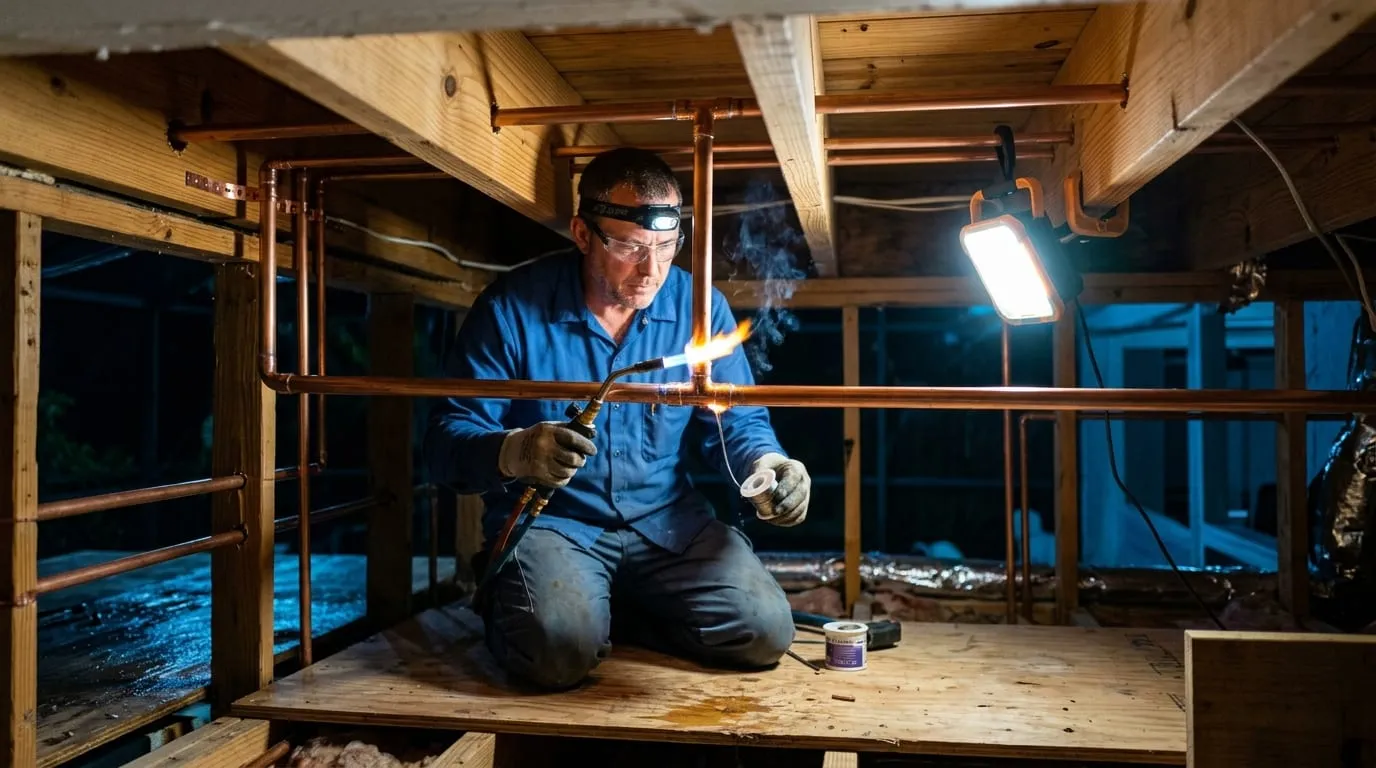
When is a repipe the right answer instead of a repair?
When the line has failed along its length rather than at a point, and that is a question about material rather than about age. Galvanized steel corrodes inward and the bore closes gradually, so it presents as pressure that fell so slowly nobody can name the day. Repairing one section of a run that is closing everywhere buys very little.
Polybutylene is the other case. The gray plastic supply used roughly between the 1970s and the 1990s becomes brittle and fails suddenly, with no warning signs before the leak, and it was the subject of a major class action. Florida insurers increasingly will not write or renew on a house that still has it.
Copper is different again. It usually fails at a point, so a repair can be honest, but along this coast salt works on it from the outside as well as the inside, and one pinhole is often a report on the whole run.
Repiping by our plumbers in Fort Lauderdale, FL replaces galvanized, polybutylene or failing copper supply lines with new pipe, after a pressure test shows what is actually in the walls. The work is done in stages, with a pressure test and inspection before the walls are closed. Drywall patching is part of the job; paint and texture matching is a separate task.
Repiping
Tell us about your pipes
Four short questions, then a person calls you back. No obligation.
- 5.0from 205 Google reviews as of
- Open 24 hours, 7 days a week
- Work performed under Florida plumbing contractor license CFC1433655
- No obligation. A person reads this and calls you back.
What you are seeing
Plumbing signs that point at the whole run, not a fitting
One fixture is a fixture problem. All of them is the pipe.
Pressure that dropped everywhere
If every tap in the house is weaker rather than one, the restriction is upstream of the fixtures. In galvanized that is the bore closing from the inside.
Rusty or discolored water
Particularly on first draw in the morning. That is the inside of the pipe arriving at the tap, and it does not improve on its own.
A second pinhole in copper
The first can be bad luck. The second in the same house says the run has reached a condition rather than had an accident.
Gray plastic supply lines
Polybutylene fails without warning, which is exactly what makes it different from everything else here. There is no symptom to wait for.
Repairs that keep moving
Fixing a leak and then finding the next one three feet further along is the clearest sign that the problem is the run, not the spot.
How the job goes
How a plumber repipes a house, from pressure test to water back on
Four steps, and the house stays usable through all of them.
- 01
Identify what is actually in the walls
Material first. Galvanized, polybutylene, copper and CPVC each fail differently, and what you have decides whether a repair is honest or whether it is a way of putting off the real job.
- 02
Agree the route
Where the new lines will run, what has to be opened to get them there, and what the finish will look like afterwards. This is the part that decides how disruptive the work feels.
- 03
Repipe in stages
A typical South Florida house is two to three days including drywall patching, and the water goes back on at the end of each working day rather than staying off for the duration.
- 04
Pressure test, inspect and close up
Tested before anything is covered, then patched. What was replaced and what was left is written down, which matters if you ever need to prove it.
Questions
Repiping questions, before you call a plumber
Will I be without water for days?
No. A typical house takes two to three days including drywall patching, and water is restored at the end of each working day. The house stays livable through the job.
Copper, PEX or CPVC?
Copper has the longest track record. PEX is flexible and resists the chlorine-related breakdown that affected polybutylene. CPVC is rigid and common in residential work. The right answer depends on the house and the route, and you get the reasoning rather than just a recommendation.
How do I know if I have polybutylene?
It is usually gray plastic, and it turns up in houses built or replumbed roughly between the 1970s and the 1990s. It is worth identifying rather than waiting for a symptom, because it does not give one before it fails.
Does it have to be the whole house?
Not always. Where the failure is at a point in copper, a repair is honest. Where the line is closing or embrittling along its length, replacing part of it means coming back for the rest, and we say so rather than selling the smaller job twice.
Do you patch the walls afterwards?
Drywall patching is part of the two to three days. Finish work like paint and texture matching is a separate trade and we tell you that at the start rather than at the end.
How much does it cost to repipe a house?
No figure is published on this site, because the material, the route and the size of the house decide the job. The plumber identifies what is in the walls first, and the price is written down before any pipe is cut.
What are the signs a house in Fort Lauderdale, FL needs repiping?
Pressure that dropped at every tap, rusty or discolored water, a second pinhole in copper, gray plastic supply lines, and repairs that keep moving from one spot to the next. Any one can be something else; several together point at the run.
Is a repipe done in stages or all at once?
In stages, and water is restored at the end of each working day. A typical house takes two to three days including drywall patching, and the work ends with a pressure test and inspection.
Related work
Plumbing services that lead to a repipe, and what follows
Repiping is rarely the first call. It is usually the second or third.
Live dispatch · 24 / 7 / 365
Pressure falling everywhere, or a second pinhole?
A person answers at any hour, and the first job is establishing what is actually in the walls before anybody quotes a repipe. Our plumbers serve Fort Lauderdale, FL and South Florida.
No obligation. Work performed under Florida plumbing contractor license CFC1433655.